PSLE English Comprehension Tips: Open-Ended Answering Guide (20 Marks)
📅 Updated: August 2026 · ✍️ By: PSLE Hero Editorial Team
In PSLE English Paper 2, Booklet B Open-Ended Comprehension (Section Q) accounts for 20 marks across 10 questions. It is often the decisive component where students lose marks due to clumsy lifting, missing key clauses, or failing to match question tense and perspective. This guide gives parents and P5/P6 students exact, step-by-step answering techniques, worked examples across all 4 core question types, and a self-check checklist.
📌 Related English Preparation Guides:
- Master the foundation rules: PSLE English Revision Tips (All Papers).
- Avoid common grammar slip-ups: PSLE English Grammar Rules Guide.
- Ace your Paper 4 oral exam: PSLE English Oral Tips (Reading Aloud & SBC).
📊 Understanding Paper 2 Open-Ended Comprehension
Paper 2 carries 90 marks in total (45% of the English subject grade). Open-Ended Comprehension sits at the end of Booklet B as questions 66 to 75 (or equivalent section numbering in current SEAB past papers).
| Aspect | Official Exam Specification |
|---|---|
| Mark Allocation | 20 marks (usually 10 questions ranging from 1 to 3 marks each) |
| Text Type | Narrative, recount, or descriptive prose (typically 500–600 words) |
| Tested Skills | Direct retrieval, vocabulary in context, inference, cause & effect, sequencing, True/False with reasons, and character feeling/trait identification. |
| Answering Rule | Full sentences required unless asked for a specific word/phrase. Language must be grammatically accurate and avoid unneeded context (excessive lifting). |
🎯 The 4 Golden Answering Rules
Follow this 4-step answering workflow for every open-ended comprehension question:
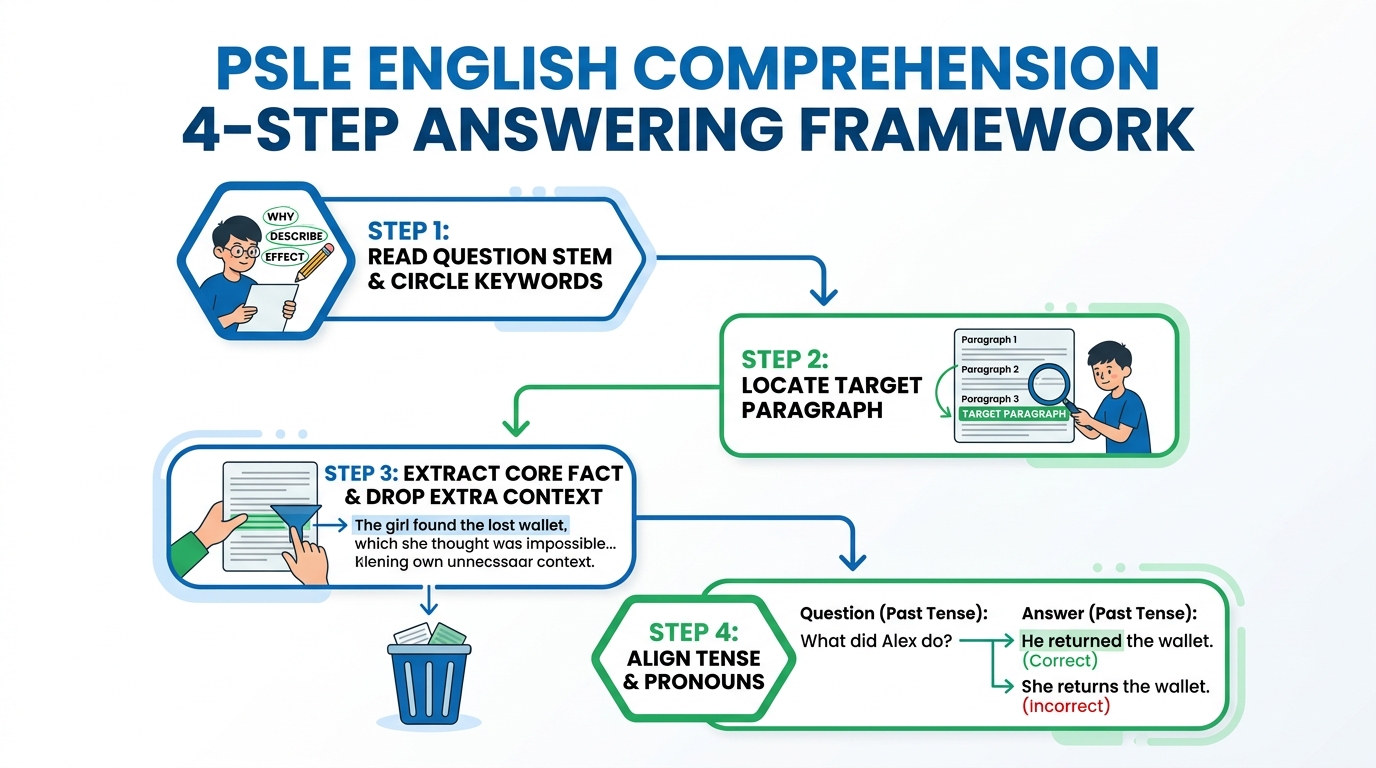
Figure 1: PSLE English Open-Ended Comprehension 4-Step Answering Workflow.
1. The "Clean Retrieval" Rule (No Excessive Lifting)
Students frequently copy the entire line from the passage including extra clauses like "As he walked down the dimly lit corridor...". Marker guidelines penalise unnecessary information because it shows the student does not know which specific part answers the question.
2. Tense & Pronoun Alignment
Always match the tense of the question. If the question asks "Why did Marcus leave?", the answer must use past tense ("He left because..."). Also update first-person pronouns in the text ("I felt scared") to third-person ("He felt scared").
3. The "Exact Word/Phrase" Boundary Rule
When asked to "find a word in paragraph 3 that means...", write only that single word. Writing a phrase or adding punctuation will result in zero marks, even if the word is included in your answer.
4. True / False Reason Structure
For True/False table questions, state the fact from the text that either confirms or contradicts the statement. Do not write "Because the statement says..." — refer directly to the character's actions or events in the passage.
📝 Worked Examples by Question Type
Consider the following passage excerpt for all 4 examples below:
Type 1: Direct Cause-and-Effect Question
Type 2: Inference & Feeling Identification
Phrase: "Tears welled in his eyes"
Type 3: True / False Statement with Reason
Reason: He eventually took the coast guard officer's outstretched hand and turned away from his hut.
Type 4: Vocabulary Matching / Word Meaning
⚠️ 4 Common Traps That Lose Marks
| Common Trap | Why Markers Deduct Marks | How to Fix It |
|---|---|---|
| Pronoun Ambiguity | Writing "He gave it to him" leaves marker unsure who "he" or "him" refers to. | Use character names in the first mention (e.g., "Marcus gave the parcel to Mr Lee"). |
| Answering with "Yes" or "No" | Wastes time and fails to provide the factual explanation required. | Start directly with the subject and verb (e.g., "The mother was angry because..."). |
| Incomplete Cause | Giving only half the reason (e.g. stating what happened without explaining why). | Use the "So What?" check: ensure your answer explains both the action and its cause. |
| Misreading Paragraph References | Searching paragraph 4 when the question specified paragraph 2. | Circle paragraph numbers in the question stem before looking back at the text. |
📋 5-Minute Parent Home Review Checklist
When marking your child's Paper 2 comprehension practice at home, review their answers against these 5 checkpoints:
- [ ] Tense Check: Does the answer match the question verb tense (past vs. present)?
- [ ] Lifting Check: Has your child removed fluff words and background setup?
- [ ] Name Check: Are proper nouns (character names) used instead of vague "he/she"?
- [ ] Word Count Check: For "word/phrase" questions, did they count the exact word count?
- [ ] Completeness Check: Does the answer completely explain the "why" or "how"?
❓ Frequently Asked Questions
Q1: How many marks is Open-Ended Comprehension in PSLE English Paper 2?
Open-Ended Comprehension sits in Booklet B Section Q of Paper 2. It contains 10 questions worth a total of 20 marks (out of 90 total marks in Paper 2).
Q2: Should students answer in full sentences for PSLE English Comprehension?
Yes. Unless explicitly asked for a single word or phrase (e.g. "Which word in paragraph 2 means..."), answers must be written in complete, grammatically correct sentences.
Q3: What is the difference between direct factual and inference questions?
Direct factual questions ask for information explicitly stated in the text. Inference questions require students to connect text clues to underlying feelings, motives, or implied consequences.
Q4: How can students avoid losing marks for lifting in PSLE comprehension?
Identify the core answer clause, replace first-person pronouns with character names/third-person pronouns, and drop preceding or trailing descriptions that do not directly answer the question prompt.
Practise PSLE English Questions on PSLE Hero
Reinforce comprehension techniques, grammar rules, and vocabulary with bite-sized daily practice questions on our mobile app.
Try Free Practice Questions