PSLE Maths Model Drawing Step-by-Step: P3 to P6 Parent Guide
📅 Published: July 2026 · ✍️ By: PSLE Hero Editorial Team & Math Specialists
Model drawing is the single most important mathematical tool in the Singapore Primary Mathematics syllabus. Developed under the Ministry of Education's (MOE) Concrete-Pictorial-Abstract (CPA) framework, bar models transform dense English word problems into clear, visual blocks of equal units. This guide provides parents with a structured, step-by-step approach to teaching model drawing from Primary 3 through Primary 6.
📖 Related PSLE Maths Guides:
• PSLE Maths General Revision Tips (Paper 1 & 2 exam techniques)
• PSLE Maths Heuristics Guide (Assumption, Working Backwards, Grouping)
• NMOS Maths Competition Guide (High-level problem sums)
⚡ Quick Summary for Parents
- Why draw models? Model drawing allows primary students to solve algebraic logic visually without needing formal algebraic variables ($x$ and $y$).
- Paper 2 Advantage: Examiner rubrics assign method marks ($M$ marks) for correct unit statements shown on a model, securing partial marks even if arithmetic calculation errs.
- The 4 Core Models: Part-Whole, Comparison, Fraction/Ratio Unit Model, and Before-After (Change) Model.
- Golden Rule: Always identify what remains unchanged (Constant Single Item, Constant Total, or Constant Difference) before completing the model.
📑 On This Page
1. The 4 Core Model Types Tested in PSLE Maths
The MOE Mathematics syllabus assesses four primary model drawing structures across P3 to P6 word problems:
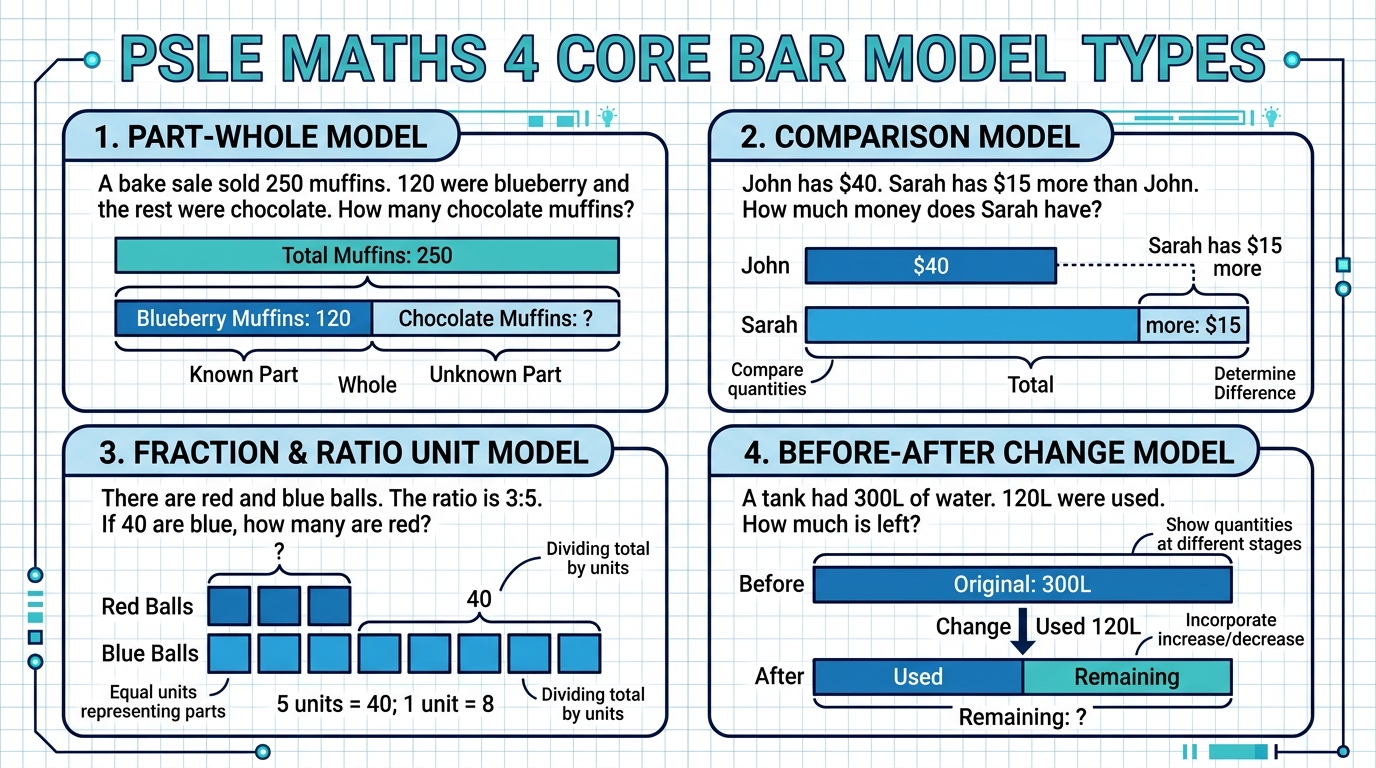
Figure 1: The 4 Core Bar Model Drawing Structures for PSLE Maths Paper 2.
Across Primary 3 to Primary 6, every bar model is built from four foundational structures. Understanding which model fits a given problem sum is the first step to solving it accurately.
| Model Type | Key Clue Words in Question | Primary Application |
|---|---|---|
| 1. Part-Whole Model | "Total", "altogether", "spent a fraction of", "remaining" | P3–P6 word problems involving addition, subtraction, fractions, and decimals. |
| 2. Comparison Model | "More than", "fewer than", "times as many", "difference between" | Comparing 2 or 3 items to find individual values or total quantity. |
| 3. Fraction & Ratio Unit Model | "Ratio of A to B is 3:5", "3/8 of the remainder", "percentage increase" | P4–P6 Paper 2 multi-step problem sums combining ratios and fractions. |
| 4. Before-After (Change) Model | "Gave away", "bought more", "in the end", "ratio changed to" | Complex P5 & P6 problem sums with state changes over time. |
2. Step-by-Step 5-Rule System for Model Drawing
Many students lose marks not because they do not understand the math, but because their bar models are untidy, unproportional, or missing labels. Teach your child these 5 habits:
- Read and Highlight Clues First: Never draw immediately. Read the complete story line and highlight quantities, changes, and final questions.
- Draw Proportional Bars: If Quantity A is 3 times Quantity B, Bar A must be visibly 3 times as long as Bar B. Accurate scaling prevents visual misinterpretation.
- Label Every Element: Place item names on the left side of the bars. Label numerical values above or inside the units.
- Partition Into Equal Units ($1u$): Subdivide bars into identical blocks. Each block represents 1 unit ($1u$).
- Mark the Target Question ($?$): Use a bracket and question mark ($?$) to indicate exactly what the question is asking for.
Parent Note: Discourage drawing models for simple 1-step arithmetic. Model drawing takes time—save it for multi-step Paper 2 word problems where visual reasoning is required.
3. Worked PSLE-Style Model Drawing Examples
Below are four step-by-step worked examples demonstrating how to construct models and write clean mathematical steps for SEAB exam marking.
Step-by-Step Working:
Answer: Lucas collected 130 stamps.
✓ Check: Lucas = 130, Ahmad = 130 + 60 = 190. Total = 130 + 190 = 320 ✓
Step-by-Step Working:
Answer: Siti had $60 left.
✓ Check: Spent on textbook = $60, spent on bag = $120. Total spent = $180. $240 − $180 = $60 ✓
Step-by-Step Working:
Answer: In 2 years' time.
✓ Check: In 2 years, Mei Ling = 14, Mother = 42. Ratio = 42:14 = 3:1 ✓. Difference = 28 ✓
Step-by-Step Working:
Answer: Ethan had 70 marbles at first.
✓ Check: Ethan = 70, Daniel = 30. Total = 100. After giving 20 marbles: Ethan = 50, Daniel = 50 (equal) ✓
4. 5 Common Model Drawing Traps Parents Should Help Avoid
- Trap 1: Confusing "Fraction of Total" vs. "Fraction of Remainder". In Example 2 above, spending $2/3$ of the remainder is completely different from spending $2/3$ of the original total. Always draw remainder bars on a second sub-level if denominators differ.
- Trap 2: Drawing Unproportional Bars. If 1 unit represents 15 items, a bar of 3 units (45 items) must be drawn three times longer. Distorted models lead children to make incorrect assumptions.
- Trap 3: Forgetting to Identify Unchanged Quantities. Before drawing a Before-After model, ask your child: "Did one person stay the same? Did the total stay the same? Or did the difference stay the same?"
- Trap 4: Over-relying on Models When Heuristics are Faster. Questions with two variables and fixed values (e.g. 40 vehicles with 2 or 4 wheels) are solved much faster using the Assumption Method rather than bar models.
- Trap 5: Missing or Incorrect Unit Labels. Every bar segment must be labelled with either the item name or the unit value ($1u$). Unlabelled bars confuse the reader and cost method marks in Paper 2 because the examiner cannot follow the student's reasoning.
5. Parent Checklist for Home Revision
📋 Daily Math Review Checklist
- ✔ Use Grid Paper: Provide 1cm grid paper for homework so your child learns to draw equal unit blocks neatly.
- ✔ Check Labels: Ensure names, brackets, and final $?$ marks are clearly drawn.
- ✔ Write Unit Statements ($1u =$): Train your child to write clear unit equations ($1u = \dots$) in every step.
- ✔ Verify Answer Reasonableness: After finding the answer, plug it back into the model to verify total conditions match.
6. Frequently Asked Questions (FAQ)
Q: Why is model drawing so important in PSLE Mathematics?
A: Model drawing translates complex English word problems into visual rectangular blocks (units). It makes abstract relationships concrete so students can identify equal units, calculate 1 unit, and earn partial method marks in Paper 2 even if final arithmetic calculation contains a minor oversight.
Q: Should students draw models for all PSLE Math questions?
A: No. Model drawing is most effective for multi-step Paper 2 word problems involving fractions, ratios, comparison, and before-after changes. Simple single-step arithmetic or specific heuristics like Assumption Method are faster for standard two-variable question types.
Q: How does model drawing help in Paper 2 mark allocation?
A: In PSLE Paper 2, marks are awarded for clear mathematical reasoning. A correctly drawn model shows the examiner the student's conceptual plan, securing method marks (M marks) even if a minor calculation error happens in final arithmetic.
Q: What are the core model types tested in upper primary school?
A: The four main types are Part-Whole Models, Comparison Models, Fraction/Ratio Unit Models, and Before-After (Change) Models. Mastering these four covers the majority of upper primary word problem structures.
Q: What is the best way to teach model drawing to a reluctant learner?
A: Start with simple Part-Whole models using familiar objects like pizza slices or candy bars. Keep sessions short — 5 minutes is enough for a P3 student. Celebrate small wins and gradually increase complexity as confidence builds.
Q: How can I tell if my child's model is correct before checking the answer?
A: Ask your child three questions: (1) Did I draw the right model type? (2) Are all units equal and properly labelled? (3) Does the total in my model match the total in the question? If all three answers are yes, the model is likely correct.
📚 Explore More PSLE Guides
Practise Model Drawing on PSLE Hero
Help your child master Part-Whole, Comparison, Fraction & Ratio Unit, and Before-After models with worked examples and step-by-step explanations inside PSLE Hero. Build speed and confidence on the exact model types covered in this guide.
Practise on PSLE Hero App