The Singapore Math Bar Model: How It Works and How to Teach It at Home
📅 Last Reviewed: July 2026 · ✍️ By: PSLE Hero Editorial Team
The bar model is the most recognised feature of Singapore Mathematics — and one of the most misunderstood. It is not a trick or a worksheet exercise. It is a structured way to make abstract quantities visible, and it works for students at every primary level, from simple addition in P1 to multi-step ratio problems in P6. This guide explains how it works, when to use each model type, and how to support your child's drawing at home.
📖 This page is part of the Singapore Primary Math series. Start with the Singapore Math parent guide for an overview of the full curriculum and method. For PSLE-specific model drawing exam technique, see PSLE Maths Model Drawing: Step-by-Step Guide.
1. Why Bar Models — Not Just for the PSLE
Many parents first encounter the bar model when helping their P5 or P6 child prepare for the PSLE. But bar models are introduced in Singapore schools as early as Primary 1, and the reason is deliberate: they are the Pictorial stage of the Concrete-Pictorial-Abstract (CPA) learning progression that underpins the entire Singapore Math curriculum.
Concrete
Physical objects — counters, cubes, fraction strips — represent numbers in the real world.
Pictorial
Diagrams — especially bar models — represent quantities and relationships visually.
Abstract
Symbols, equations, and eventually algebra represent the same ideas without pictures.
The bar model is the bridge between handling real objects and writing equations. A child who can draw and label a bar model correctly has already done most of the mathematical thinking. The arithmetic that follows is secondary.
This is why the bar model is used internationally — by homeschool families in the United States, international schools in Europe and Australia, and families relocating to Singapore who are new to the method. The underlying skill being developed — representing relationships visually before solving — transfers well beyond the Singapore school system.
2. The Three Core Bar Model Types
There are three main bar model structures in Singapore primary mathematics. Each suits a different class of problem. Students learn to recognise which type fits a question before they start drawing.
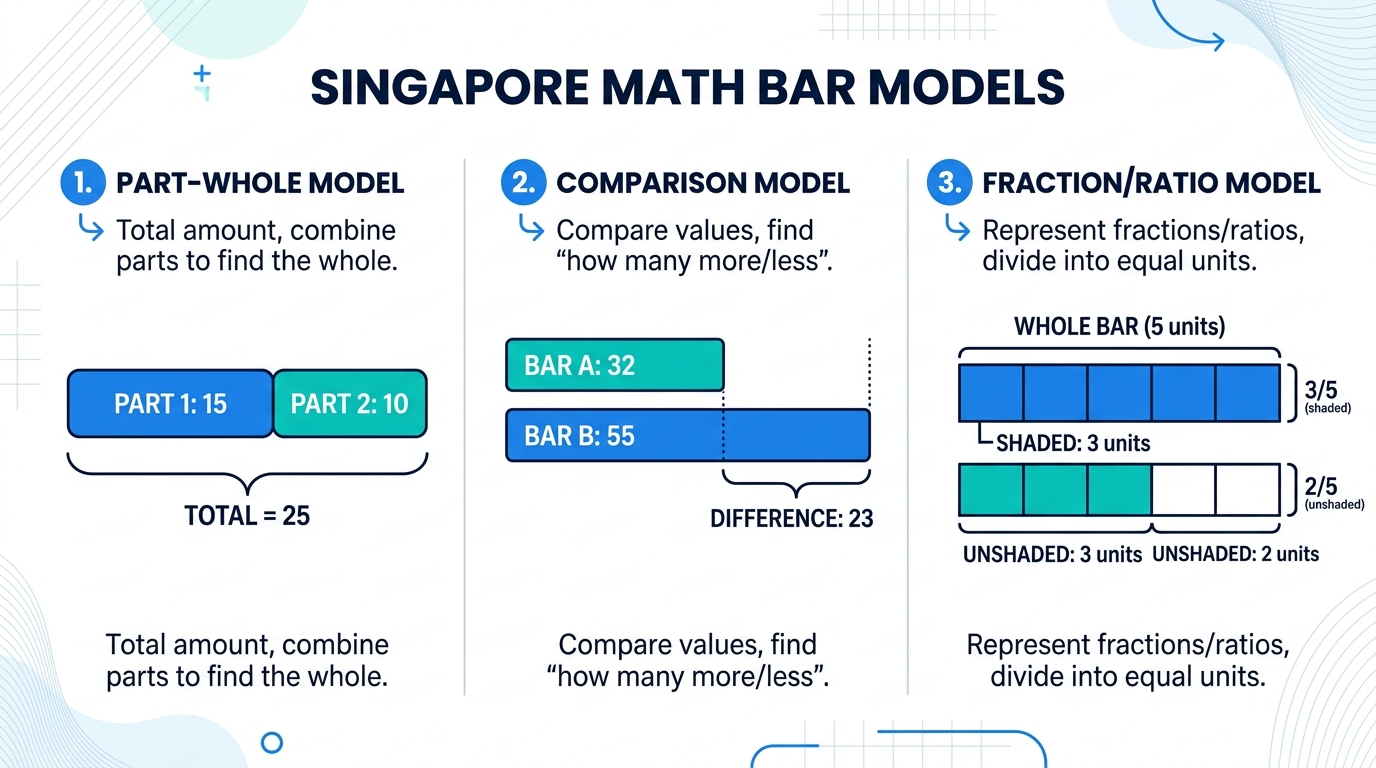
Figure 1: Overview of the 3 Primary Bar Model Structures (Part-Whole, Comparison, Fraction/Ratio).
What it shows: How two or more parts combine to make a total (the whole). It is the foundational model, introduced in P1.
Use it when: The question involves a total and its parts, and asks for a missing part or the whole. Keywords: "altogether", "total", "in all", "how many more to make…"
There are 48 apples in a basket. 19 are red. The rest are green. How many green apples are there?
Green apples = 48 − 19 = 29 apples
What it shows: The difference between two (or more) quantities, drawn as bars of different lengths placed one above the other.
Use it when: The question compares two people, groups, or quantities. Keywords: "more than", "less than", "times as many", "fewer", "how many more/fewer".
Mia saved $135. She saved $47 more than her brother Jake. How much did Jake save?
Jake [ ————————— ][ $47 ] = same total bar
Jake's savings = $135 − $47 = $88
A box of mangoes weighs 3 times as much as a box of limes. Together they weigh 56 kg. How much does the box of limes weigh?
Mangoes [1u][1u][1u]
Total = 4 units = 56 kg
→ 1 unit = 56 ÷ 4 = 14 kg
The box of limes weighs 14 kg.
What it shows: A bar divided into equal units to represent fractions, ratios, or percentages. This is the most powerful model type for upper primary students.
Use it when: The question involves fractions of a quantity, ratios between two groups, or percentage change. Keywords: "fraction of", "ratio of", "what fraction is…", "2 : 3".
Priya spent 2/5 of her pocket money on a book. She had $36 left. How much pocket money did she start with?
[1u][1u] = spent on book
[1u][1u][1u] = $36 remaining
3 units = $36 → 1 unit = $12
Total = 5 units = 5 × $12 = $60
The ratio of boys to girls in a class is 3 : 4. There are 12 boys. How many students are there in total?
Girls [1u][1u][1u][1u]
3 units = 12 → 1 unit = 4
Total students = 7 units = 7 × 4 = 28 students
3. When Each Model Type Is Introduced (P1 to P6)
Bar model drawing is developed gradually. Understanding which model a student should already know helps parents provide the right support without introducing concepts too early.
Part-Whole with small numbers
Students draw simple two-part bars for addition and subtraction problems within 100. The bar is often drawn freehand; precision matters less than the concept. Labels are single numbers.
Comparison models introduced
Students begin drawing bars of different lengths to show "more than" and "fewer than" relationships. Multiplication and division are introduced; some students begin using unit notation ("1u") for equal groups.
Fraction and multi-step models
Bar models are divided into equal units to represent fractions of a set. Two-step problems require two different model diagrams or combined models. Accuracy in proportional drawing becomes more important.
Ratio models; before-and-after
Ratio problems require the student to equate unit values across two bars. Before-and-after models show a situation before and after a change (transfer, addition, or removal) — a structure that replaces the need for simultaneous equations. Ratio and before-after problems are the defining skills of the P5 year — see the Primary 5 Maths guide for what else it introduces.
Combined models; algebra bridge
The hardest P6 problems combine fractions, ratios, and percentages in a single question. Students draw multi-section bars and may need to equalise units across two scenarios. The "1u" notation is effectively a visual form of algebra — preparation for the formal variable introduced in P6.
4. Five Rules for Drawing Bar Models Correctly
These rules apply at every level, from P1 to P6. Students who follow them produce cleaner diagrams and make fewer errors.
- Use a pencil and ruler. Straight lines make proportions clearer and mistakes erasable. Freehand bars at P4+ introduce proportion errors that mislead the student.
- Keep bars of equal units the same width. If 1 unit = 1 segment width, then 3 units must be exactly 3 times as wide. Disproportionate drawing creates confusion when checking the answer.
- Label every part. Write the known value inside (or above) each bar segment. Write a "?" in any segment that is the unknown. Never leave a segment unlabelled.
- Write the total or relationship outside. Use a curly brace or bracket to indicate what the full bar represents. Write the total value beside it.
- Start with the unit you know, not the one you want. Draw the bar whose value is given first. Then draw the second bar relative to the first. Working in the opposite direction is the most common student mistake.
Tip for parents: If your child draws a bar model and gets confused, ask them to point to each segment and say what it represents aloud. If they cannot explain each part in words, the diagram is not yet doing its job. The drawing should match the sentence structure of the question.
5. Common Bar Model Mistakes — and How to Fix Them
❌ Drawing proportionally wrong bars
A bar for "3 times as many" drawn at the same size as the reference bar. The visual no longer represents the relationship.
✅ Fix: Estimate proportions deliberately
Before drawing, ask: "Is the bigger bar 2× or 3× the smaller one?" Sketch lightly first, then firm up with a ruler once the proportion looks right.
❌ Skipping the diagram for "simple" problems
Students who skip bar models on P4 problems often make errors on P5–P6 problems where they must now draw under pressure with unfamiliar structures.
✅ Fix: Draw even when you think you don't need to
The bar model builds a mental habit. Students who draw routinely at P4 find P5 diagrams less intimidating because the process is automatic.
❌ Mixing up the whole and the part
After finding 1 unit, the student answers with "1 unit" instead of the relevant multiple. They found the part but answered with the value of the wrong segment.
✅ Fix: Re-read the question after solving
Circle the exact question being asked before drawing. After finding 1 unit, go back and check: "Did the question ask for 1 unit, 3 units, or the total?"
❌ Using letters instead of unit notation
Writing "x" instead of "1u" introduces formal algebra before students are ready and causes confusion with the P6 algebra syllabus.
✅ Fix: Stay with "1u" notation until P6 algebra
Unit notation ("1u, 2u, 3u") is the Singapore primary standard. It naturally bridges to algebra in P6 without conflicting with it.
6. Bar Models and Algebra: How They Connect
A frequent question from parents — especially those from educational systems that introduced algebra earlier — is: "Why draw bars instead of just writing an equation?"
The answer is developmental. Research in mathematics education (and the experience of Singapore teachers since the 1980s) shows that students who build visual understanding of unknown quantities are better equipped to handle formal algebra later. The label "1u" in a bar model is conceptually the same as "x" in an equation — but a 9-year-old can reason about a labelled box far more intuitively than about a letter variable.
When formal algebra is introduced in P6 (and extended in secondary school), students who are fluent bar model drawers tend to transition more easily. The bar model has already trained them to think: "There is something I don't know. I can represent it. I can find its value by using what I do know."
Note for parents from other countries: If you are used to teaching your child to set up equations immediately, you may find the bar model method feels slower. It is not. For the types of word problems in the Singapore primary curriculum — especially ratio and fraction problems — a well-drawn bar model often produces the solution with far less algebraic manipulation than the equation approach would require at this level.
7. How to Support Bar Model Drawing at Home
You do not need to be a mathematics teacher to help your child with bar models. The following approach works well for parents at any confidence level.
- Read the question together and underline the numbers and the key words ("more than", "fraction of", "ratio"). Ask: "How many things are being compared?"
- Ask which model type fits. "Is this a part-whole question, a comparison question, or a fraction/ratio question?" Let your child decide. Prompt if needed but resist telling them the answer.
- Watch the drawing, not just the arithmetic. If the bar diagram is wrong, the arithmetic will almost certainly be wrong too. Correct the diagram before looking at the numbers.
- Check by substituting back. Once an answer is found, replace the unknown in the original problem with the answer and verify the problem statement is satisfied. This habit catches errors at every level.
Quick home practice idea: Take any simple division problem from daily life — sharing items equally, splitting a bill — and ask your child to draw a bar model for it before solving. Five minutes a day of this builds the drawing habit faster than any worksheet.
8. Related Guides
Continue learning — Singapore Primary Math series:
PSLE-specific model drawing guides:
- PSLE Maths Model Drawing: Step-by-Step Guide — exam-level worked examples with Part-Whole, Comparison & Before-After
- PSLE Maths Heuristics: Step-by-Step Guide — how to use bar models alongside other heuristics in the PSLE
- PSLE Maths Tips: Problem-Solving Strategies & Exam Techniques
Practise Bar Models with Worked Examples
Reading about bar models is one step — drawing them under practice conditions is another. The Singapore Primary Math app offers structured practice questions at every primary level, with step-by-step solutions that show the bar model alongside the working.
Try Singapore Primary Math on Android9. Frequently Asked Questions
My child is in P3 and has never drawn a bar model. Is it too late to start?
No. P3 is actually an ideal time to build the habit, because the numbers are still manageable and the question structures are not yet too complex. Start with simple Part-Whole diagrams using P3-level numbers. Once the habit is established, introduce Comparison models.
Should the bars be drawn to scale?
They should be proportionally reasonable — a bar representing 3 units should look roughly 3 times as long as one representing 1 unit. They do not need to be perfectly to scale, but wildly disproportionate bars create misleading visuals that confuse the student. A quick rough sketch is fine as long as relative sizes are clear.
What is the difference between the Part-Whole and the Comparison model?
In the Part-Whole model, the bars are placed end-to-end to form a complete whole. In the Comparison model, the bars are placed one above the other and the difference between them is highlighted. The choice depends on whether the question is about a total (Part-Whole) or a difference (Comparison).
How is this guide different from the PSLE model drawing guide?
The PSLE model drawing guide focuses on the exam context — how to draw and label models to maximise marks in Paper 2, with PSLE-difficulty worked examples. This guide explains the bar model from first principles, covering all three model types and how they develop from P1 to P6. It is suited to parents who are new to the method or who want to support a younger child.
← Back to Singapore Math Guide | → Privacy Policy | ← PSLE Hero Home