PSLE Science CER Framework: Claim-Evidence-Reasoning with Worked Examples
📅 Last Reviewed: July 2026 · ✍️ By: PSLE Hero Editorial Team
Many Primary 5 and Primary 6 students know their Science concepts well but lose marks in Booklet B because their answers are incomplete, vague, or missing the scientific reasoning that markers look for. The CER (Claim-Evidence-Reasoning) framework is a practical answering structure that helps students organise complete, precise explanations. This guide explains how the CER framework works, compares weak and strong answers, provides five original worked examples across all PSLE Science themes, and gives parents a simple checklist to use at home.
1. Why Students Lose Marks in PSLE Science Booklet B
Booklet B of the PSLE Science paper contains structured open-ended questions that require written explanations. Many students who score well on multiple-choice questions lose marks here — not because they lack science knowledge, but because they do not structure their answers completely.
Common reasons students lose marks include:
- Jumping straight to a conclusion — stating the result without explaining the process that led to it.
- Omitting scientific keywords — using everyday language instead of precise syllabus terms like evaporation, heat conductor, or photosynthesis.
- Failing to use evidence — not quoting data, observations, or values from the question's diagram, table, or graph.
- Confusing observations with explanations — describing what happened ("the water level dropped") without explaining why ("because water evaporated").
The CER framework addresses all four problems by giving students a repeatable three-step structure to follow for every open-ended question.
2. What Is the CER Framework?
The CER (Claim-Evidence-Reasoning) framework is a structured answering strategy commonly taught by many educators to help students organise scientific explanations. It is not an official SEAB marking rubric, but it mirrors the logical structure that markers expect: state your answer, support it with evidence, and explain the science behind it.
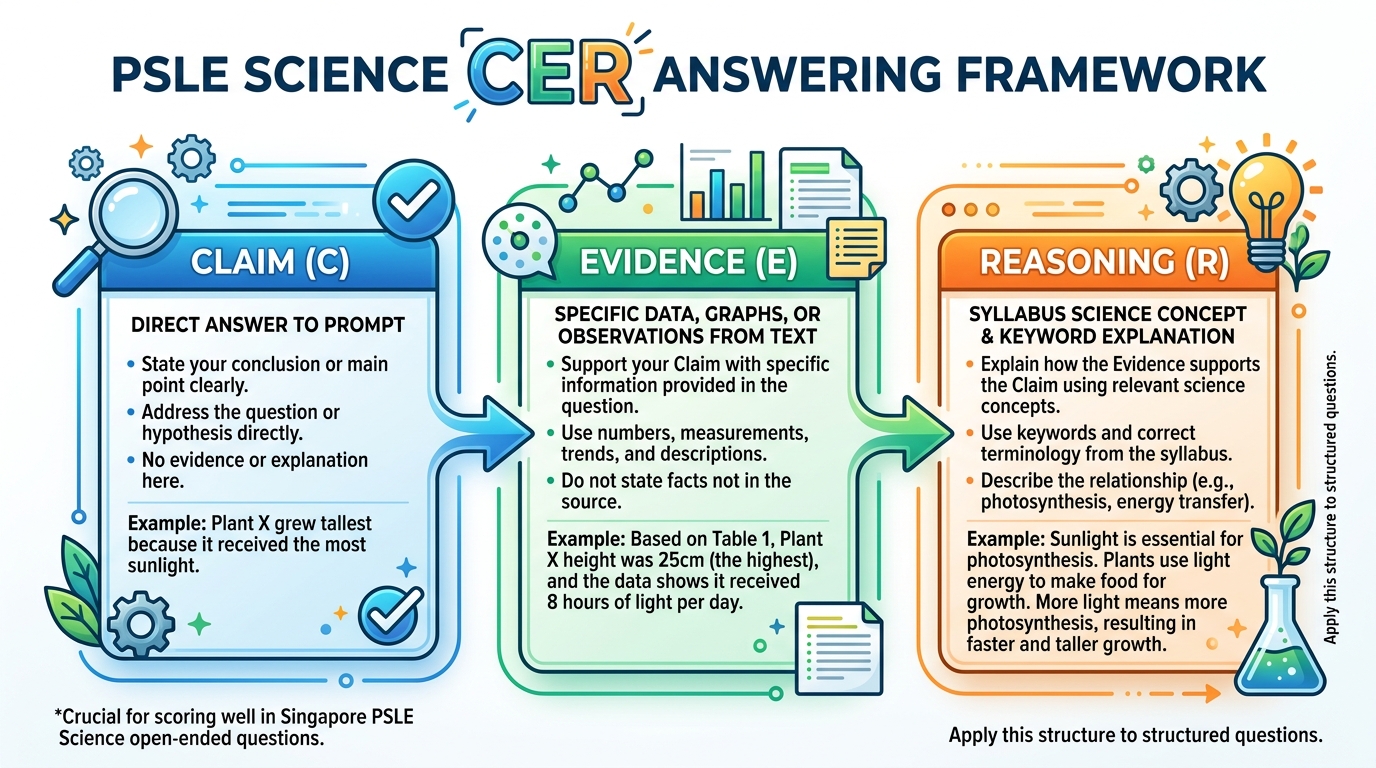
Figure 1: Claim-Evidence-Reasoning (CER) 3-part Answering Structure for PSLE Science Booklet B.
Claim
A direct answer to the question. The claim is one clear sentence that states what happened, what will happen, or what the student believes. It must address the question exactly as asked.
Example: "The ice cubes in the beaker wrapped in cloth melted slower."
Evidence
Specific information from the question that supports the claim. This may come from diagrams, data tables, graphs, experimental results, or observations described in the question. Evidence must be quoted or described precisely — avoid vague statements.
Example: "After 20 minutes, the ice cubes in Beaker A (wrapped in cloth) had melted by 10 ml, while those in Beaker B (unwrapped) had melted by 25 ml."
Reasoning
The scientific concept or mechanism that connects the evidence to the claim. This is the most important part — it explains why the evidence supports the claim using correct scientific terminology from the syllabus.
Example: "Cloth is a poor conductor of heat / heat insulator. It reduced the rate of heat gain from the surroundings, so less heat energy was transferred to the ice cubes, slowing the melting process."
CER at a glance: Start from the question, state a clear Claim, back it with Evidence from the question or experiment, then link both with scientific Reasoning.
| CER Component | What It Does | What Happens If Missing |
|---|---|---|
| Claim | Answers the question directly | Answer is unclear or off-topic |
| Evidence | Quotes specific data or observations | Answer feels generic and unsupported |
| Reasoning | Explains the science mechanism | Answer lacks depth — marker cannot tell if the student understands the concept |
Observation vs Explanation: An observation describes what happens ("the ice cubes melted faster"); an explanation uses CER to say why ("the metal spoon conducted heat from the surroundings to the ice cubes, speeding up melting").
3. Poor Answer vs Excellent CER Answer
The best way to understand the CER framework is to compare a weak answer with a strong CER-structured answer side by side.
Scenario
A gardener places two identical potted plants in two different rooms. Plant A receives 6 hours of sunlight per day. Plant B receives no sunlight but is otherwise given the same amount of water and air. After two weeks, Plant A has grown 8 cm taller and has darker green leaves than Plant B.
Question: Explain why Plant A grew taller and had darker green leaves than Plant B after two weeks.
| AL4 / AL5 Answer (Weak) | AL1 CER Answer (Strong) |
|---|---|
| "Plant A got more sunlight so it grew better." | Claim: Plant A grew taller and had darker green leaves because it received sunlight, which allowed it to carry out photosynthesis. Evidence: Plant A received 6 hours of sunlight daily while Plant B received none. After two weeks, Plant A had grown 8 cm taller and its leaves were darker green. Reasoning: Sunlight provides the light energy needed for photosynthesis. During photosynthesis, plants use chlorophyll (found in leaves) to convert carbon dioxide and water into glucose (food) and oxygen. The glucose produced is used for growth (cell division and enlargement). Without sunlight, Plant B could not photosynthesise sufficiently, so it produced less glucose and therefore grew less. The darker green colour of Plant A's leaves indicates more chlorophyll, which is necessary to capture light energy for photosynthesis. |
Why the CER answer earns full marks: The weak answer states a correct general idea but is too short. It does not use any scientific keywords, does not quote evidence from the question, and does not explain the underlying process. The CER answer does all three: it names photosynthesis, chlorophyll, light energy, glucose, and growth as keywords; it cites the specific growth difference (8 cm) and sunlight difference; and it explains the complete mechanism connecting sunlight to plant growth.
4. Five Original Worked Examples
Each example covers a different PSLE Science syllabus theme. Use these to help your child see how CER applies across different topics.
Example 1: Heat & Energy
Scenario: A student places a metal spoon and a wooden chopstick in a cup of hot water at 80°C. After 5 minutes, she touches the parts above the water surface. The metal spoon feels much hotter than the wooden chopstick.
Question: Explain why the metal spoon feels hotter than the wooden chopstick at the part above the water surface.
Scientific concept: Heat conduction — different materials conduct heat at different rates.
Important keywords: heat conductor, poor conductor of heat, heat insulator, conduct heat, heat energy
CER Breakdown
Claim: The metal spoon feels hotter because metal is a better heat conductor than wood.
Evidence: Both objects were placed in the same cup of hot water at 80°C for 5 minutes. The spoon is made of metal and the chopstick is made of wood.
Reasoning: Metal is a good heat conductor — it allows heat energy to travel quickly from the hot water up to the part above the surface. Wood is a poor conductor of heat (or heat insulator), so heat energy travels much more slowly through the chopstick. As a result, more heat reaches the spoon's handle in the same time, making it feel hotter to the touch.
Full Model Answer
Metal is a good heat conductor while wood is a poor conductor of heat (an insulator). When both objects are placed in hot water, heat energy is transferred from the hot water along the objects more quickly through the metal spoon than through the wooden chopstick. Therefore, the part of the metal spoon above the water surface becomes hotter in the same amount of time, so it feels hotter to touch.
Example 2: Forces & Motion
Scenario: A boy rolls two identical balls down two different ramps. Ramp A is smooth (varnished wood). Ramp B is covered with sandpaper. Both ramps have the same height and length. The ball on Ramp A reaches the bottom faster.
Question: Explain why the ball on Ramp A reaches the bottom faster than the ball on Ramp B.
Scientific concept: Friction — rough surfaces produce more friction, which opposes motion.
Important keywords: friction, rough surface, smooth surface, opposes motion, gravitational force
CER Breakdown
Claim: The ball on Ramp A reaches the bottom faster because the smooth surface produces less friction.
Evidence: Ramp A is made of smooth varnished wood while Ramp B is covered with rough sandpaper. Both ramps have the same height and length, and the balls are identical.
Reasoning: Friction is a force that opposes motion between two surfaces in contact. The rough sandpaper on Ramp B creates more friction between the ball and the ramp surface compared to the smooth varnished wood of Ramp A. The greater friction on Ramp B slows the ball down more, so it takes longer to reach the bottom. The ball on Ramp A experiences less opposing friction, so it can accelerate faster under the same gravitational force.
Full Model Answer
The ball on the smooth ramp (A) reaches the bottom faster than the ball on the rough ramp (B). This is because the rough sandpaper surface of Ramp B creates more friction between the ball and the ramp. Friction is a force that opposes motion, so it slows the ball down. The smooth wooden surface of Ramp A produces less friction, so the ball experiences less opposing force and rolls down faster.
Example 3: Plant Systems (Adaptation)
Scenario: Two types of plants are grown in the same garden. Plant X has large, thin leaves. Plant Y has small, thick leaves covered with a waxy layer. During a dry period with very little rain, Plant Y survives while Plant X wilts and dies.
Question: Explain how the features of Plant Y help it survive better during a dry period.
Scientific concept: Plant adaptation — leaf structure affects water loss through transpiration.
Important keywords: transpiration, water vapour, surface area, waxy layer, cuticle, adaptation
CER Breakdown
Claim: Plant Y survives better because its features reduce water loss during the dry period.
Evidence: Plant Y has small, thick leaves covered with a waxy layer, while Plant X has large, thin leaves. During the dry period, Plant Y survived and Plant X died.
Reasoning: Transpiration is the loss of water vapour from the leaves of a plant. The small leaves of Plant Y have a smaller surface area, which reduces the amount of water lost through transpiration. The thick waxy cuticle on the leaves also helps reduce water loss by forming a waterproof barrier. In contrast, Plant X's large, thin leaves have a larger surface area and lack a thick waxy layer, so it loses water rapidly through transpiration and cannot survive when soil water is scarce. These features are adaptations that help Plant Y conserve water.
Full Model Answer
Plant Y has small, thick leaves and a waxy layer. Small leaves have a smaller surface area, which reduces the rate of transpiration (water loss as water vapour). The waxy layer (cuticle) also helps to reduce water loss. These are adaptations that allow Plant Y to conserve water and survive longer during a dry period when water is limited.
Example 4: Cycles & Matter (Water Cycle)
Scenario: A student places a shallow dish of water on a table in a sunny room. After 3 hours, the water level in the dish has decreased noticeably. She then places the same dish of water in a shaded corner of the same room and observes that after 3 hours, the water level has decreased much less.
Question: Using the concept of the water cycle, explain why the water level decreased faster in the sunny spot than in the shaded spot.
Scientific concept: Evaporation — rate of evaporation depends on temperature.
Important keywords: evaporation, water vapour, heat energy, temperature, rate
CER Breakdown
Claim: The water level decreased faster in the sunny spot because evaporation occurred at a faster rate.
Evidence: The dish in the sunny spot lost noticeably more water in 3 hours than the same dish in the shaded spot. Both dishes had the same amount of water at the start and were observed for the same duration.
Reasoning: Evaporation is the process by which water changes from a liquid to water vapour. Heat energy is required for evaporation to occur. The sunny spot received more direct sunlight, which raised the temperature of the water and its surroundings. The higher temperature provided more heat energy, causing water molecules to gain enough energy to escape into the air as water vapour at a faster rate. In the shaded spot, less heat energy was available, so evaporation occurred more slowly.
Full Model Answer
The water level decreased faster in the sunny spot because evaporation happened at a faster rate. Evaporation is the process where water gains heat energy and turns into water vapour. The sunny spot receives more direct sunlight, so the temperature is higher. The higher temperature provides more heat energy to the water, causing water molecules to evaporate more quickly. In the shaded spot, less heat energy is available, so evaporation is slower and the water level decreases less in the same time.
Example 5: Electrical Systems
Scenario: A student builds a simple circuit with a battery, three identical bulbs (Bulb 1, Bulb 2, Bulb 3), and connecting wires. Bulb 1 and Bulb 2 are connected in series with each other. This series combination is then connected in parallel with Bulb 3. When the circuit is closed, Bulb 3 lights up brightly, but Bulb 1 and Bulb 2 are dim.
Question: Explain why Bulb 3 lights up more brightly than Bulb 1 and Bulb 2.
Scientific concept: Series vs parallel circuits — voltage distribution in different circuit arrangements.
Important keywords: series circuit, parallel circuit, voltage, current, electrical energy, brighter / dimmer
CER Breakdown
Claim: Bulb 3 lights up more brightly because it is in its own parallel branch and receives the full voltage, while Bulb 1 and Bulb 2 share the voltage in a series arrangement.
Evidence: The circuit uses a single battery with three identical bulbs. Bulb 1 and Bulb 2 are in series with each other, and this combination is in parallel with Bulb 3. When the circuit is closed, Bulb 3 is bright while Bulb 1 and Bulb 2 are dim.
Reasoning: In a series circuit, the voltage of the battery is divided between the components. Bulb 1 and Bulb 2 are in series, so each receives only part of the total voltage (approximately half each for identical bulbs). Less voltage means less electrical energy is converted to light and heat, so they appear dimmer. In a parallel circuit, each branch receives the full voltage of the battery. Bulb 3 is in its own parallel branch, so it receives the full battery voltage, making it brighter.
Full Model Answer
Bulb 3 is brighter because it is in a parallel branch by itself and receives the full voltage of the battery. Bulb 1 and Bulb 2 are in series, so the battery voltage is divided between them — each receives less voltage and therefore converts less electrical energy, making them dimmer.
5. Top 3 Common Mistakes and How to Fix Them
Mistake 1: Confusing observation with explanation
Many students describe what they see without explaining why it happens. For example, writing "the water level went down" instead of explaining "the water evaporated because it gained heat energy from the surroundings".
How to fix: After writing the observation, ask "Why does this happen?" The answer to that question is the explanation. Use your child's Science textbook or guide to identify the correct reasoning for each topic.
Mistake 2: Repeating the question without scientific reasoning
Some students rephrase the question as their answer without adding new information. For example, if the question is "Why does the ice cream melt faster on a hot day?", a weak answer might be "Because the weather is hot".
How to fix: Teach your child to always include the scientific mechanism — not just the trigger but the process. A stronger answer would be: "On a hot day, the surrounding temperature is higher. More heat energy is transferred to the ice cream, causing the ice particles to gain energy and change from solid to liquid (melt) faster."
Mistake 3: Missing important scientific terminology
Using everyday words instead of syllabus keywords costs marks. For instance, writing "the plant makes food" instead of "the plant carries out photosynthesis to produce glucose" misses the precise terms that markers look for.
How to fix: Create a keyword list for each Science theme (Systems, Cycles, Diversity, Interactions, Energy) and practice inserting the correct term into every answer. One method is to underline or circle the required keyword in the model answer and compare it with the student's own answer.
6. Printable CER Checklist
Print this checklist and keep it with your child's Science revision materials. Before submitting any Booklet B answer, run through these four checks:
☐ CER Quick-Check for PSLE Science Answers
Remember: Claim → Evidence → Reasoning. Tick off all four checklist items before you move on to the next question, and always end with the scientific keyword that ties the answer to the syllabus theme.
7. Frequently Asked Questions
What is a PSLE Science open-ended question?
A PSLE Science open-ended question appears in Booklet B and requires a written explanation rather than choosing a multiple-choice answer. These questions are typically worth 2–4 marks and test the student's ability to explain scientific phenomena, predict outcomes, compare observations, or describe fair tests using precise scientific language.
Is the CER framework compulsory for PSLE Science?
No. The CER framework is a teaching tool, not an official SEAB marking requirement. Students may answer in any logical structure as long as the answer is complete, accurate, and uses the correct scientific terms. CER simply helps students remember to include all the necessary parts.
How long should a PSLE Science open-ended answer be?
There is no official word count. A practical guideline is 2–4 sentences for a 2-mark question and 4–6 sentences for a 3- or 4-mark question. Every sentence should add value — either stating a scientific fact, citing evidence, or explaining the reasoning.
Why are scientific keywords so important?
Markers use specific syllabus keywords to determine whether a student understands the concept or is describing it in general terms. Using the correct keyword (e.g. transpiration instead of "water loss from leaves") signals precise understanding and is a reliable way to earn full marks.
What is the difference between Claim, Evidence, and Reasoning?
The Claim is a direct answer to the question. The Evidence is specific data or observations from the question's diagram, table, or graph. The Reasoning is the scientific concept or mechanism that connects the evidence to the claim — it explains why the evidence supports the answer using correct science vocabulary.
How can parents help children practise the CER method at home?
Take any PSLE Science practice question and ask three simple prompts: "What is your answer?" (Claim), "What information from the question supports that?" (Evidence), and "What science concept explains why?" (Reasoning). With regular practice, these three steps become automatic.
Does the PSLE Hero app include CER model answers for Science?
Yes. The PSLE Hero app provides step-by-step model answers for every Science open-ended question, with keywords highlighted and the CER structure clearly shown. Students can compare their answers against the model to identify exactly which grading points they covered.
8. Keep Practising
Learning the CER framework is the first step. The real improvement comes from applying it repeatedly across different Science questions — from Heat & Energy to Cycles, from Forces to Electrical Systems. Each time your child practises, the three steps become more natural, and their answers become more complete.
Reading about the CER approach is only the first step. Students improve by applying the method across many different Science questions.
If you would like more structured practice with step-by-step explanations and keyword guidance, explore the Science practice modules available in the PSLE Hero app.
→ PSLE Science Tips: How to Prepare, Answer & Score Well
→ PSLE Science Open-Ended Questions Guide
→ PSLE Science Experimental Questions Guide
→ Free PSLE Practice Questions
→ Privacy Policy | → Data Deletion Request | ← Back to PSLE Hero